

Eco UCOV® ensures sustainable packaging solution
The volume of global packaging is steadily increasing and with it the negative impact on the environment. The transition to a circular economy is of essential importance to us. We want to improve the environmental impact of our product throughout their whole life cycle – including production, transport, use and disposal.
With Eco UCOV®, Daeheung IBN criteria in the development and production of its well-known plastic container series for solid and liquid medications which play an important role in designing sustainable packaging solutions and thus contribute to greater environmental compatibility.

Material
Which plastic material can be used? Due to the overall increase in environmental awareness, consumers pay more attention today to environmentally friendly packaging. Where feasible, resource-saving, or recycled materials should be used. Eco UCOV® offers both possibilities.
What is GEX?
Global Certification
SGS Eco Product Certification
As the world’s leading inspection, verification, testing and certification company, SGS is recognized as a provider of an international standard for quality and reliability.
SGS Eco Product is a voluntary product environmental labeling program in which labels on products that meet excellent environmental standards are provided.
The certification process includes all stages of a products entire life cycle, taking into account relevant and interrelated environmental indicators from the extraction of resources to production, use and disposal stages of the product.
After the environmental impacts that occur in the entire process are quantitatively evaluated, certification marks are given to products with excellent environmental performance which have obtained scores above a certain level.
- Reduce Plastic Usage(Less Plastic 30%)
- Reduce CO2 Emission
Guideline for Reducing Plastic Waste – ‘GRP’ Certification
GRP ( Guidelines for Reducing Plastic Waste & Sustainable Ocean and Climate Action Acceleration ) is the global environmental guidelines and certification for climate change adaption and reduction of plastic usage.
Additionally, GRP is published on Best Practice in Mainstreaming SDGs. The contents cover 30 main backgrounds and 39 global guidelines including comprehensive information on global environmental issues such as plastic usage reduction, marine environment protection, and climate change adaption based on location, scale, socioeconomic environment, corporate opportunity, system, the effectiveness of implementation, innovation, future vision, etc.,

UN Sustainable Development Goals (SDGs)

The fifth report of the IPCC
(Intergovernmental Panel on Climate Change)
UN COP21 (Paris Climate Change Accord)

Reports of the UN Ocean Conference
Provides guidelines for global enterprises’ plastic reduction and activities of climate change adaption. Reducing petrochemical and plastic products is a key part of the GRP. In addition, GRP covers petrochemical, material, fashion retail, food and beverages, cosmetic and accommodation and restaurant sections. Enterprises with outstanding performance in GRP can be approved as a partner enterprise.
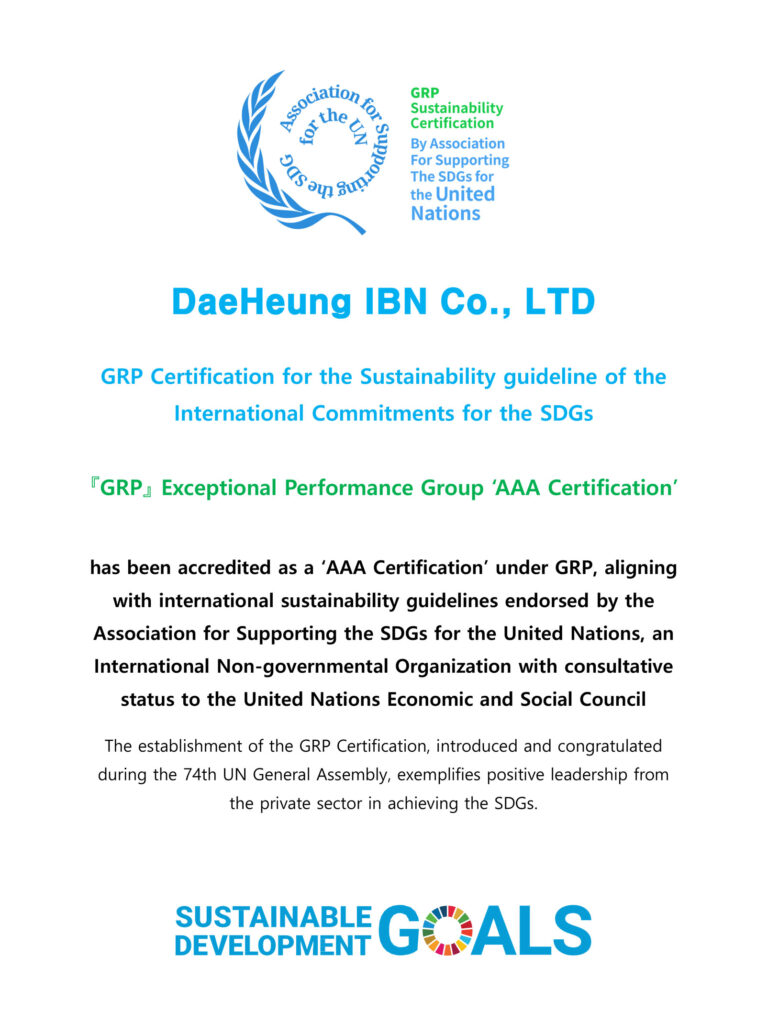
Certification of GRP for 7 main purposes:
The following are the 7 points that are considered in the GRP and which ASD is striving to cope with throughout the project.
We urge you to beware of the environmental expenses which the government, the National Assembly, and the global corporations have to cover for the current environmental pollution, especially marine pollution. In the Asia-Pacific coastal area, where extensive ocean pollution occurs, the member states of the Asia-Pacific Economic Cooperation (APEC) bear the expenses of about $1.3 billion a year.
We recommend global corporations take concrete actions to cut the usage of plastic, which is the main cause of marine pollution. The world produces 330 million tons of plastic every year and about 12 million tons of it flows into the ocean and breaks down into small pieces and becomes a micro-plastic. The amount of plastic in the ocean today is enough to circle the Earth about 400 times.
We suggest fast fashion companies prevent overuse of water and let the contaminated water out into the ocean. Currently, 7,000 to 10,000 liters of water are used to make a pair of jeans, and 2,700 liters of water, accounting for 20 percent of the wastewater that fast fashion companies send to the ocean.
We conduct campaigns on the issues of global warming and resource development, which causes the North and South Poles to disappear. When the glaciers in the Arctic Ocean, including Greenland melt, there will be a 6.5-meter rise in sea level from the current level, and when the Antarctic ice sheet melts, it will rise at 73 meters. Half of the U.S. population lives within 80 kilometers of the coast, and 40 percent of the world’s population, including Asia, Europe, and Africa, live in coastal areas, so the rise in sea level is expected to bring about a huge climate crisis.
We run carbon-reducing campaigns for enterprises and people to cope with the environmental crisis which is directly related and closely interlinked to our lives such as fine dust.
We urge eco-friendly production lines for all plastic manufacturing enterprises. Also to make an institutional framework, we continually discuss it with the National Assembly.
We recommend global eco-friendly fundraising and the issue of sustainable bonds